How we transform businesses with AI
Rolling out AI without context is like hiring talented people and sending them straight into meetings without onboarding. Here is the blueprint for building a "Second Brain" for your organization, so that AI tools actually drive transformation and create value.
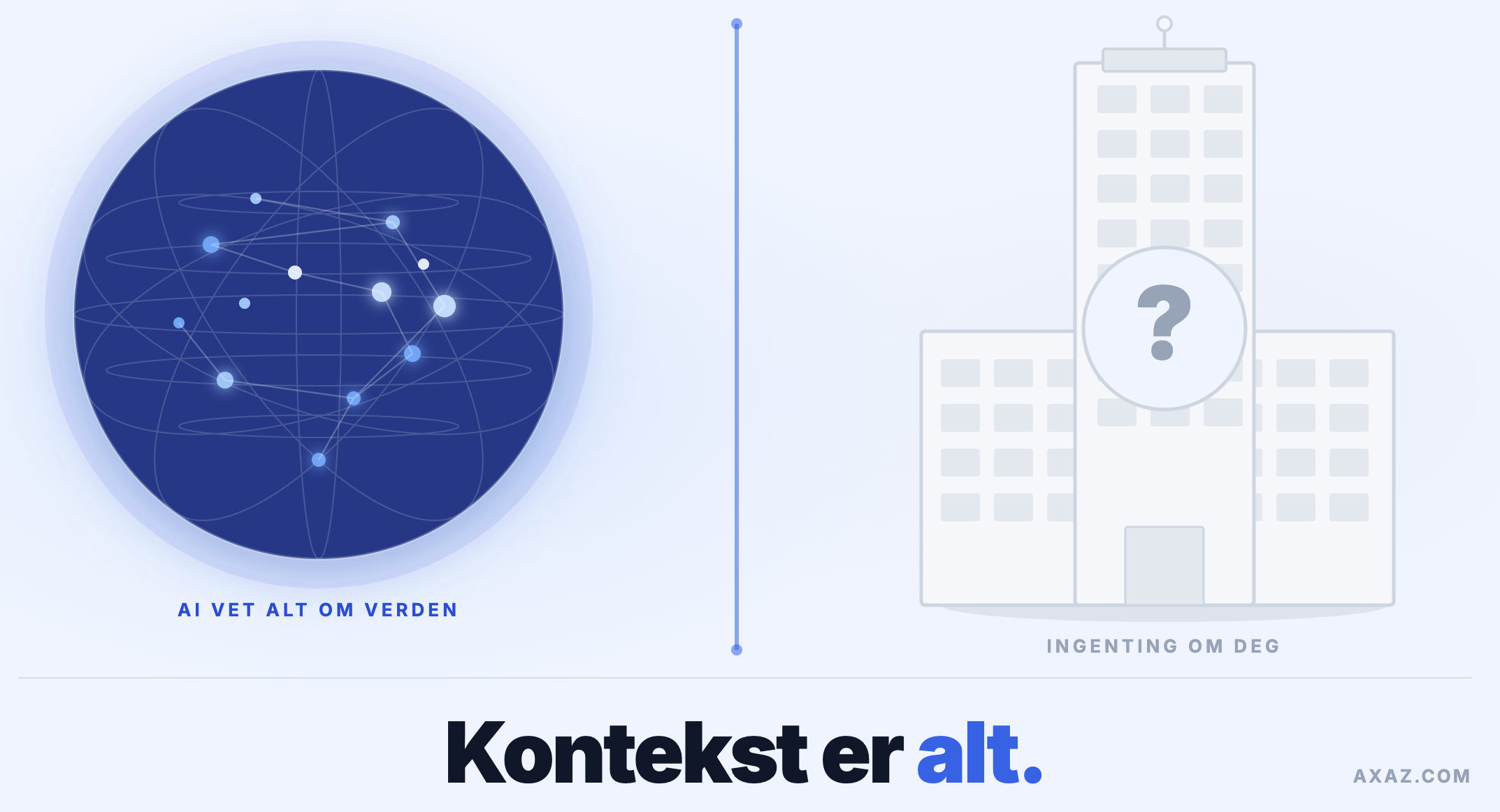
Most businesses have now conducted the same experiment: purchased licenses for ChatGPT or Copilot, sent out an email stating that "everyone now has access to AI," and then waited for something to change.
Nothing changed. Or rather, some people became a bit faster at writing emails or better at Excel, but the transformation never happened.
The reason isn't that AI is overrated. The reason is that a generic tool without context about your business is like hiring someone and sending them straight into meetings without onboarding. They might be talented—but they are just guessing.
A second brain — for an individual
Author and productivity guru Tiago Forte popularized the concept of a second brain. The idea is that we can externalize knowledge and thoughts into a system outside our own heads. Instead of trying to remember everything, we store it in a structured and searchable place, freeing up mental capacity for what actually requires creativity and judgment.
This works well for individuals, but what happens to organizations?
Knowledge becomes fragmented. It lives in Teams chats, Confluence pages that haven't been updated since 2021, PowerPoint presentations saved on SharePoint—or perhaps locally—and, not least, in the heads of the people who will one day leave. You end up starting more or less from scratch with every delivery or new hire.
The question is not whether your business needs a second brain, but how to build one.
An employee without onboarding — and an agent without context
We have an internal concept we keep coming back to: an AI agent without context is like a new hire without onboarding.
Hiring talented people without the necessary information or tools is inefficient; you end up with a conversational partner rather than a contributor.
The same applies to AI without a context strategy. Without insight into your architecture, guidelines, and strategy, the answers remain generic.
Transformative is when the AI knows who you are, what you work on, and what is true in your specific situation and organization. This is what creates value!
How we’ve done it for developers
Instead of the AI agent in the IDE only knowing general programming knowledge, it has access to our actual context—codebase, architectural principles, documentation on the applications we work on, and best practices. We have made this structured information available via an MCP server that maintains permissions and security.
Combined with an AI-powered IDE, this gives developers two things at once:
Context: The AI knows what we are building, how and why
Assistance: The AI can help with writing, debugging, and understanding code in light of that context
The result is not just that developers write code faster. It is that they make better decisions faster - because they always have access to the collective knowledge of the entire team, not just their own experience and what they remember from last time.
A junior developer with good context beats a senior without it. That is the fundamental shift.
From developer teams to the entire organization
This is not specific to developers, and it should not be limited to them either.
The salesperson who always knows what the customer needs. The professional who never starts from scratch. The manager who gets answers across the business immediately. The proposal that is ready in minutes because the AI knows the methodology, the pricing model, and how you win.
Same architecture, new context. This is how the "second brain" mindset scales from one team to the entire organization: Externalize collective knowledge, make it accessible, and let the AI be the interface.
Control is not a hindrance - it is a prerequisite
Secure implementation is not the opposite of fast implementation. It is what makes it possible.
We see two extremes. Organizations that are so afraid of risk that they do nothing. And organizations that roll out AI without thinking holistically about architecture and security.
Both end up with no value.
Some key factors for success:
Access control as an architectural principle, not an afterthought. The AI can never see more information than the individual would have had access to in the same role. The context server respects the same access rules as the rest of the system. This is not optional, but an absolute requirement
Human-in-the-loop where it matters. The AI suggests, humans decide. Especially in the beginning, when the system is new and trust has not yet been established, this is crucial. Over time, you can expand the autonomy of the system.
Gradual rollout with measurable results. We started with one team with a clearly defined need, learned from it, and rolled it out more broadly.
The technical foundation: Standardization and accessibility
What we prioritized early on was building a single architecture that can be reused across teams and use cases. What we built for the developers is essentially the same thing we can build for everyone else. New data sources, same foundation.
The alternative is an ad hoc solution for every team. That is technical debt from day one and an organization that never aligns.
Order matters
Structure and content create the value
Start with the data structure, not the AI layer. It is tempting to start with the visible agent layer, but the value lies in the quality of the context it is provided. Poorly structured, outdated, or fragmented data leads to poor answers, no matter how good the model is. The most transformative work is about cleaning up the knowledge structure, not about choosing the right LLM provider.
Involve people early. This is a strategic shift that must come from the top, but be anchored within the organization. You succeed best where the users themselves have defined which problems they want to solve, rather than the decision being "now we are using AI."
Measure what matters to the business, not what is easy to measure. The number of AI-generated lines of code is a poor metric. Time from idea to production, reduced error rates, shorter onboarding time for new employees, autonomous processes with quality — these are metrics that actually indicate whether the system is creating value.
The way forward
We are not finished. No one is finished. This field is moving too fast for anyone to call themselves finished.
But we have a direction we believe in. The structures are in place, but they must be iterated upon. A second brain is alive and evolves with the company.
AI is not magic, and it is not inherently wise. It is wise to the extent that it has access to good, structured, updated context, and to the extent that the people around it are involved in the right way. Productivity gains come from exactly this, and the better the models become, the more it will be able to contribute. The agent is the interface and the colleague. What it operates on is everything the organization knows, gathered, controlled, and searchable. Give it the right structures and frameworks, and you change how the organization thinks, decides, and acts.
The question is not whether you should do it, but when.
How we work with
AI
at Axaz?