Buy off the shelf, build the difference: Lessons from the SaaSpocalypse
The SaaSpocalypse turned around: SaaS lives on, but the line between buying and building has moved. Here is the answer for those who want to buy standard tools and build their own where they differentiate.

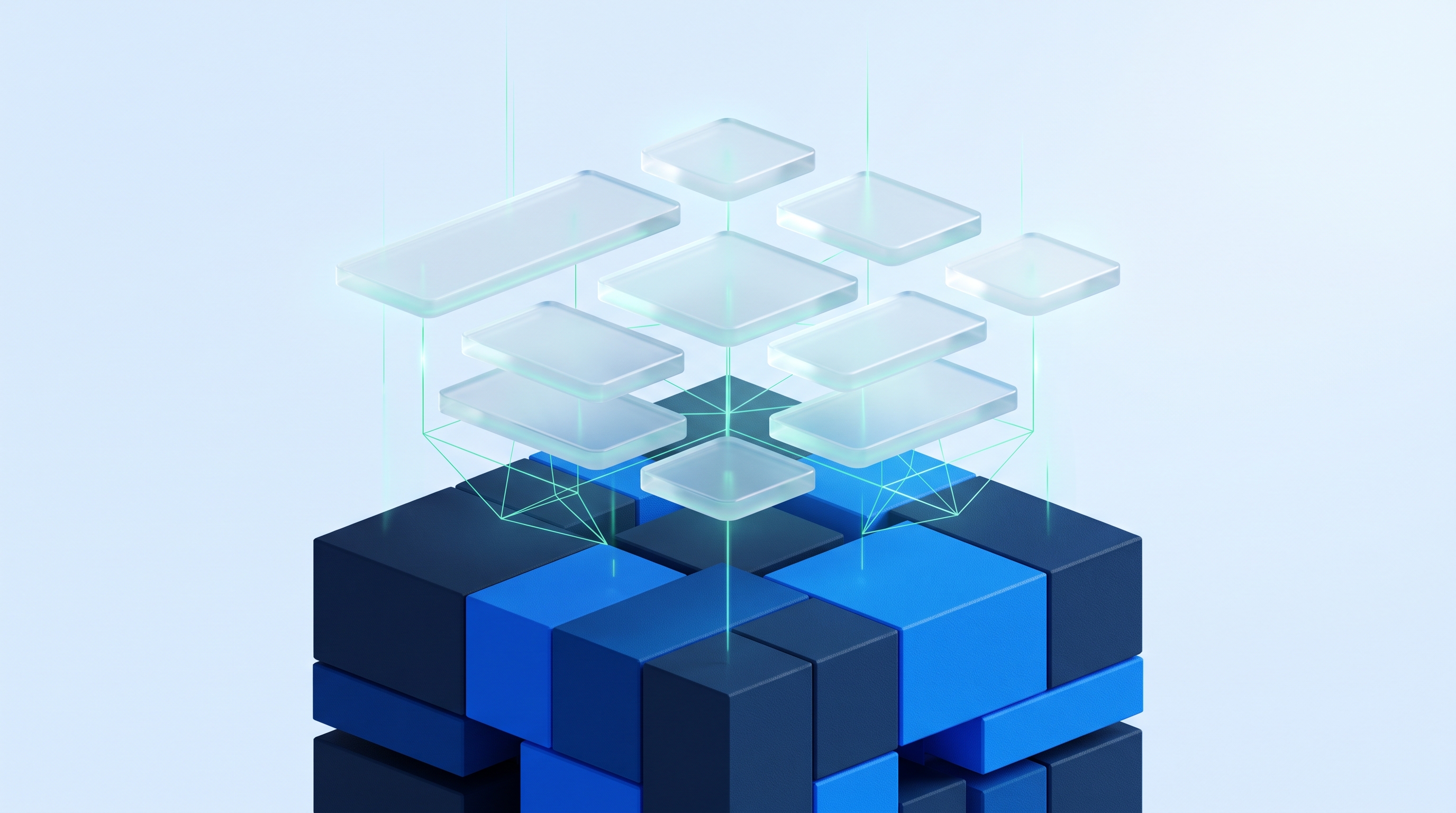
In February 2026, the tech markets tanked. Almost 300 billion dollars in market value vanished from software companies in a few days, and analysts gave it a name that stuck: the SaaSpocalypse. The story was that AI agents would replace the software businesses pay for. Why buy a CRM when you can prompt your way to one?
Six months later the picture has flipped. Salesforce reports double-digit growth and calls the doom "nonsense". Nine of the ten leading AI companies have themselves become heavy CRM users. And the market that sold everything in panic has started rewarding exactly the software that carries the core data of the business.
What emerged from the panic is neither doomsday nor business as usual. It is a much clearer recipe for how modern organisations should assemble their technology portfolio: Buy off the shelf for standard needs like sales, customer service and marketing. Build your own where you actually differentiate. And avoid the two classic traps: building the standard yourself to save on licences, or letting hype decide what is what.
In this article you get the evidence that ended the SaaSpocalypse, the distinction that explains which software dies and which becomes more valuable, and what this means in practice for your CRM, your data quality and your AI strategy.
How the panic spread
It began in September 2024, when Klarna announced it was dropping Salesforce and Workday in favour of AI and its own systems. When Anthropic launched tools in January 2026 that could build software and run workflows on their own, the story exploded: Over a few days in February, around 300 billion dollars in market value disappeared from software stocks, the analyst firm Jefferies christened the phenomenon the "SaaSpocalypse", and a key software index fell 32 percent from its peak, the most oversold reading since 1990.
The reasoning behind the panic was simple: AI agents break the link between the number of employees and the number of licences, and when the interface becomes a chat, the value that lived in menus and buttons disappears.
Why the story turned
The turnaround didn't come as one event, but as quarterly numbers that gradually contradicted the doom. Salesforce delivered double-digit growth throughout the period, and in August the stock rose almost 23 percent in a single day, the second-best day in the company's history. Benioff's verdict on CNBC was blunt: "This SaaSpocalypse narrative has been such nonsense. Frontier models depend on CRM. They don't replace it." The fact that nine of the ten leading AI companies use Salesforce themselves, with a 435 percent increase in spend in one year, added credibility.
At the same time, the symbol itself turned out to be more nuanced than the headlines. As early as March 2025, Klarna's CEO said he was "tremendously embarrassed" by the portrayal: They had never replaced their CRM with a language model, only consolidated fragmented data. The company later reinvested in human customer support, because the cuts had lowered quality.
By August 2026 the panic was over, and the question changed character. It was no longer about whether AI would replace software, but which software would lose ground and which would become more important. Aaron Levie of Box summed it up well: The thesis that AI agents are bad for software wasn't entirely wrong, but misread.
Two markets, not one
Here is the real insight that came out of the panic: AI doesn't kill SaaS. AI splits the software market in two.
Core systems (systems of record) are the pillars of the business: CRM, ERP, HR systems, PIM, security solutions and more. They are deeply integrated in the organisation, subject to compliance requirements and expensive to replace. These systems become more valuable in the AI era, not less. When AI agents are to do work in the business, they need a safe and governed data foundation to operate from. Data is the moat, and agents make it deeper.
Workflow tools (systems of engagement) are the thin tools where the interface itself is the product: simple content work, simple analysis, lightweight case handling. When the interface becomes natural language, that moat collapses. This is where the real disruption is happening now: Price pressure at renewals, functionality built in-house, and tools being merged.
The distance between prototype and production is already visible. Gartner predicts that over 40 percent of all AI agent projects will be cancelled by the end of 2027. Not because AI doesn't work, but because the projects meet the reality of the business: security, compliance, audit trails, integrations and operational stability. All of this is already built into the core systems. It doesn't come with a prompt. "It's very easy to build something that is shiny, but those things don't run properly. They are vibe-coded," says Fabien Cros of Ducker Carlisle.
Ask the question about every tool in your portfolio: Does it carry master data, or is it an interface? The answer decides whether you should buy, build or replace.
The new answer: Buy the standard, build the difference
The narrative that has stuck is neither "SaaS is dead" nor "everything carries on as before". It is far more useful for anyone responsible for a technology portfolio:
Buy off the shelf for standard needs. Sales tools, ticketing systems, marketing tools and collaboration platforms cover needs you share with thousands of other organisations. Recreating them yourself gives no competitive advantage, and the maths rarely works: Vendors spread development, operations and AI investment across their entire customer base. That is an economy of scale no single organisation can match on its own. Buy the standard, but set requirements for data quality, open APIs that let the system integrate with the rest of the landscape, and security and privacy built in from the start. Then put the AI features to use where they demonstrably deliver value.
Build where you actually differentiate. AI coding tools have drastically lowered the cost of building software. So the question is no longer whether you can build, but what you should build. The answer: the processes that are unique to your business, the customer experiences that define you, and data-driven services your competitors can't copy. This is where the investment pays off. Everything else is cost.
Don't build the standard yourself to save on licences. The licence saving is rarely a real saving. It only moves the bill from the software vendor to your own IT department. Development, operations and maintenance continue for years after delivery, while the off-the-shelf vendor keeps improving the product, the security and the AI features. If you build standard functionality yourself, you have in practice taken on a new cost line with a worse service level.
So this is not a binary choice. Modern organisations now operate with a deliberate portfolio: off-the-shelf as the foundation, custom where it matters, and AI agents on top of both. Those who do worst are the ones who let panic or hype decide the mix.
What does this mean for your CRM?
CRM was the clearest example of the whole shift. CRM was first on the doom list, because seat-based pricing and heavy interfaces were exposed. In 2026 the same system is described by the AI industry itself as a prerequisite: The most advanced AI models need customer data, business context and governance, and that is exactly what a well-run CRM delivers.
The consequences for you as a leader:
- Data quality is now AI strategy. An AI agent operating on duplicates, outdated records and inconsistent fields makes wrong decisions faster. The principle of garbage in, garbage out has been given a turbo version.
- Business context is the raw material of AI. For AI to do real work, it must know your business: value proposition, customer history, agreements, processes and earlier decisions. Without that knowledge, agents can only give generic answers. The CRM is where this context is captured and made available. It is the difference between AI that guesses and AI that actually understands your business.
- The CRM must be integrated. When agents are to read and write across systems, the value of clean connections to ERP, invoicing and the data warehouse multiplies. A CRM as an isolated island becomes a risk.
- Governance is not optional. Access control, audit trails and consent management must be in place before you let agents loose on customer data, not afterwards.
- Seat count is no longer the whole picture. The discussion about usage- and outcome-based pricing is real. Expect vendors to change how they charge, and make sure you pay for value, not for seats.
The good news: None of this requires panic. It requires a plan.
The Axaz method: Process first, technology after
The SaaSpocalypse debate, with all its noise, has confirmed what we at Axaz have always meant: Technology choices should follow business processes, not the other way around.
The answer above is easy to say and hard to follow. It is exactly the job we do at Axaz every day. We are a certified partner for both HubSpot and Salesforce, and can compare the two big ecosystems neutrally. Our advice is based on your processes, not on which platform we sell.
We don't build more than necessary, but we don't stop at standard configuration either. When the difference is to be built, our own application service does the job: custom, user-centred applications on the same data foundation as the CRM. One partner, one delivery model, and AI used where it demonstrably delivers value, both in the solution and in the implementation itself.
The organisations that come out strongest from this phase are not the ones that buy the most or build the most. They are the ones that choose deliberately.
Book a CRM chat with us, and get a neutral view of where you should buy, build and integrate.
Sources
- CNBC: "'SaaSpocalypse' debate intensifies as software stocks swing wildly" (07.08.2026)
- CNBC: "Salesforce CEO Marc Benioff says the 'SaaSpocalypse' is nonsense" (26.08.2026)
- Forbes: Lutz Finger, "SaaSpocalypse Is Dead: The Future Of SaaS Is SaaS" (24.04.2026)
- TechCrunch: Julie Bort, "Salesforce CEO Marc Benioff: This isn't our first SaaSpocalypse" (25.02.2026)
- SalesforceBen: "Klarna CEO 'Tremendously Embarrassed' by Salesforce Fallout" (14.03.2025)
- The SaaS CFO: "The SaaSpocalypse: AI Agents, Vibe Coding, and the Changing Economics of SaaS" (10.03.2026)
- Philipp Dubach: "The SaaSpocalypse Paradox" (13.02.2026)
- The Economist: "Fear of the SaaSpocalypse is tormenting techland" (10.06.2026)
How we work with
CRM
at Axaz?